370 Kilometres Out, 7,500 Metres Down: Inside Somalia's First Deep-Sea Oil Gamble
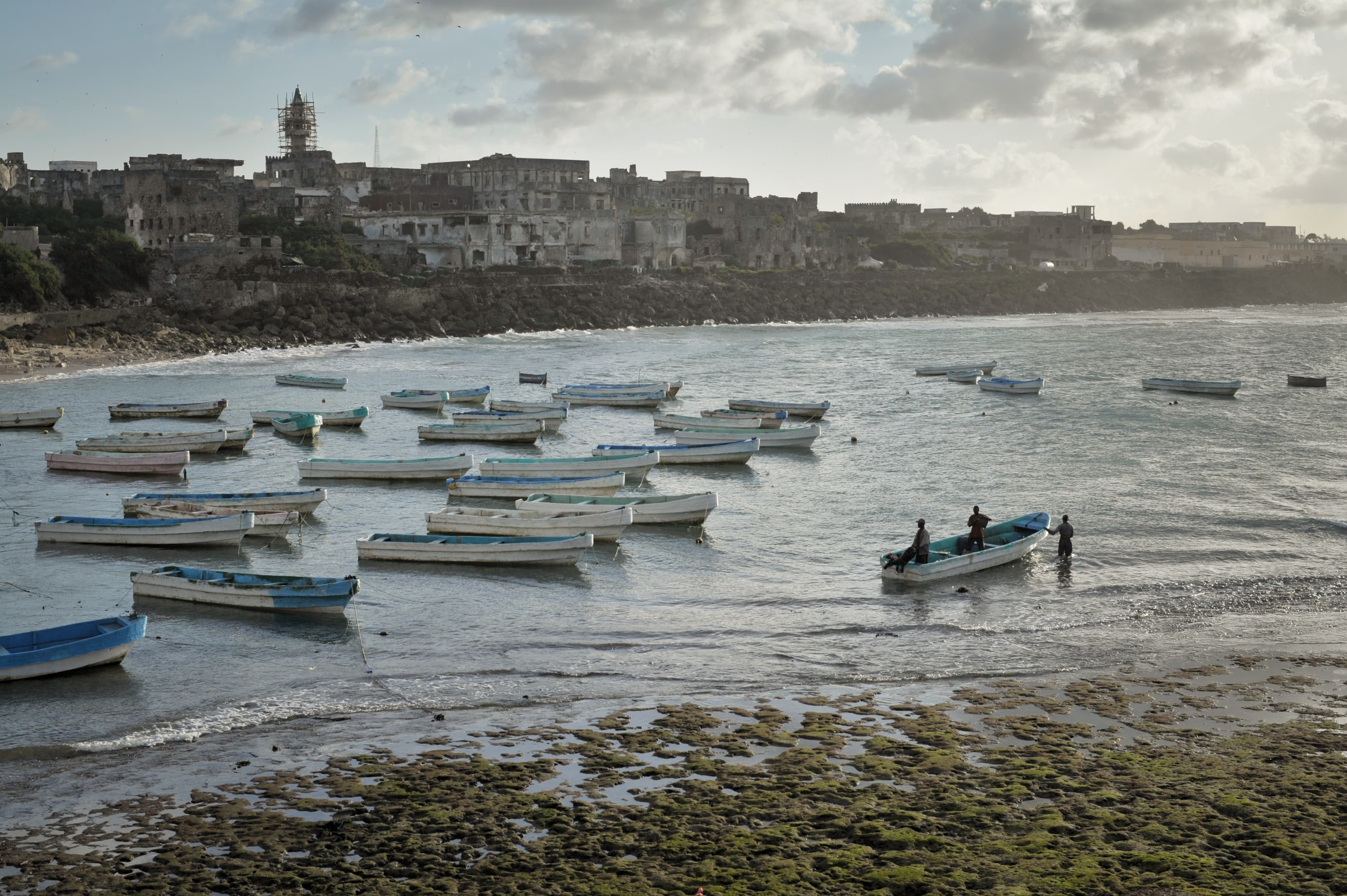
Turkey's drillship Cagri Bey is three months into drilling Somalia's Curad-1 well, the country's first-ever offshore test — a high-risk, high-reward bid to unlock reserves estimated at 30 billion barrels.
Three hundred and seventy kilometres northeast of Mogadishu, in water nearly two miles deep, a South Korean-built vessel the length of three football pitches has spent the better part of three months doing something no ship has ever done in Somali waters: drilling for oil.\n\nThe drillship is the Cagri Bey, operated by Turkey's state energy company, Turkish Petroleum Corporation (TPAO). It arrived off the Somali coast in early April 2026 under naval escort, having sailed 45 days around the Cape of Good Hope because its 114-metre derrick is too tall to pass through the Suez Canal. Its target, the Curad-1 well — Somali for \"firstborn\" — sits in roughly 3,480 metres of water and is being drilled to a total depth of about 7,500 metres below the seabed, a scale that would rank it among the two or three deepest offshore wells ever attempted anywhere in the world.\n\nTPAO and Turkish officials, including Energy and Natural Resources Minister Alparslan Bayraktar, put the operation's expected duration at roughly 288 days from spud to completion, meaning results are not likely before late 2026. As of this month, drilling continues; neither TPAO nor Somalia's Ministry of Petroleum and Mineral Resources has announced a hydrocarbon strike, and none should be expected for months yet. What has changed since the ship's arrival is less about geology than geometry: it is now Somalia's longest-running, farthest-offshore industrial undertaking, full stop.\n\nWhy a well, and why here\n\nThe site was not chosen blind. TPAO's seismic vessel Oruc Reis spent roughly seven months in Somali waters in 2024 and 2025, gathering 3D seismic data across some 4,464 to 4,500 square kilometres spanning three licensed offshore blocks. Turkish officials say the resulting data pointed to a single prospective structure worth the enormous cost of an ultra-deepwater test — industry estimates put a single deepwater exploration well like this at $40 million to well over $100 million, a sum entirely beyond Somalia's own fiscal capacity.\n\nThat financing gap is the whole logic of the arrangement. Under a hydrocarbon exploration and production agreement signed in Istanbul in March 2024, TPAO holds exclusive rights to explore three offshore blocks covering roughly 16,000 square kilometres, with a parallel onshore agreement following in 2025. Turkey brings the drillship, the seismic vessel, the naval escort — a Turkish frigate group has shadowed both vessels throughout, citing piracy and militant risks along the coast — and the capital. Somalia, in a country where per-capita income sits near $592 and where the World Bank and the Fragile States Index both rank it among the most fragile economies on Earth, could not credibly run this operation alone.\n\nThe arithmetic Somalis are doing at home\n\nThat dependence is precisely what has made the deal contentious inside Somalia. Reporting on the agreement's text — including analysis by The Africa Report and OilPrice.com of the contract terms — has detailed a production-sharing structure that lets TPAO recover up to 90% of operating costs before profit-sharing begins, exempts the Turkish company from signature bonuses and Somali taxation, and routes any legal disputes to courts in Istanbul rather than international arbitration or Somali courts. Somalia's own share, under that structure, is commonly cited at around a 5% royalty on gross production.\n\nMembers of Somalia's Parliamentary Natural Resources Committee have argued publicly that the deal bypassed competitive bidding procedures required under the 2020 Petroleum Law, and that Mogadishu signed away exploration rights in waters and blocks that federal member states such as Puntland and Jubaland consider partly their own jurisdiction, without adequately consulting them. Puntland and Jubaland's governments have separately clashed with the federal government this year over Turkish-mediated political talks, a friction that runs on a parallel track to, but colours perceptions of, the energy partnership.\n\nSupporters of the deal — including Somali Petroleum Minister Dahir Shire Mohamed, who has publicly called the process transparent and said \"the good days are coming\" for the country's youth — counter that a flawed deal that gets a well drilled beats a pristine one that never leaves the negotiating table. Somalia, they argue, has neither the capital, the trained engineers, nor the security apparatus to survey and drill its own deepwater blocks; Turkish firms already run Mogadishu's port and airport, and a Turkish naval presence has effectively underwritten the country's maritime security for a decade.
What a strike would actually mean\n\nThe number that keeps recurring in coverage of Somalia's offshore prospects is 30 billion barrels — a US government estimate of the country's total oil and gas potential, which if borne out would place Somalia's reserves behind only Libya's and Nigeria's on the continent. That figure remains unproven; Curad-1 is a single exploration well, not a confirmed field, and dry holes are common even after promising seismic surveys. But a genuine discovery at this depth and scale would be the first hard evidence that decades of speculation about Somalia's offshore basin have a real geological basis — and would put a country that has known almost nothing but war, drought and aid dependency since 1991 in charge of a resource most of its neighbours would envy.\n\nThe honest version of the story, for now, sits between those two poles: a genuinely historic drilling campaign, proceeding on schedule roughly three months in, whose economic and political consequences depend entirely on what the drill bit finds over the next several hundred metres — and on whether Somalia's institutions are ready, when it does, to manage what comes next.
